
Coweta County Release Records
A release record explains how a person left one specific place of custody. At Coweta County Jail, that event stays tied to the local booking and often to a court case. At Coweta County Correctional Institution, the same word may describe parole, a maximum-sentence discharge, a transfer, or a move to community supervision. Absence from the Sheriff’s online inmate catalog proves none of those events by itself. The public record may have aged out, the name may differ, or custody may have moved to another agency.
“Released” also does not always mean free in the community. A person can leave the Greison Trail jail for Georgia Department of Corrections custody, another county, a federal hold, or immigration custody. A bond release may return someone to the community while the case remains pending. Time served means the custodial part of a sentence has been credited as complete, but probation may still follow. Discharge generally marks the end of the correctional term or the status recorded by the responsible corrections agency.
Coweta County Release Types
The correct search depends on why custody ended. Coweta County Jail holds local arrestees, pretrial detainees, short-sentence inmates, and people awaiting transfer. The correctional institution on Selt Road houses state and county offenders in a prison setting. These release paths create different records and different next steps.
| Release event | Meaning and next record |
|---|---|
| Bond | Local custody ends after an authorized bond is posted, unless another hold applies. Check P2C, the court order, and the Sheriff release record. |
| Time served or sentence complete | The custodial term is credited as complete. The court record may still show probation or another condition. |
| Court order or dismissal | A judge or case disposition authorizes release. The docket is the best long-term source for what happened to the case. |
| Parole | A state prisoner leaves confinement under supervision. Use the parolee database and Georgia Department of Community Supervision. |
| Transfer | The person leaves one facility but remains in another agency’s custody. Search the receiving county, GDC, BOP, or ICE as applicable. |
| Maximum release or discharge | A state correctional sentence reaches its recorded endpoint. Use GDC’s inactive-offender and sentence-status tools. |
- Parole
- Conditional release from a prison sentence under state supervision.
- Probation
- A court-ordered term served in the community, sometimes after jail time.
- Discharge
- The recorded end of a correctional or supervision term.
- Detainer
- A request or legal hold that can keep a person in custody for another agency.
Coweta Release Record Fields
A Coweta County jail release record can carry more detail than the public catalog displays. The Police-to-Citizen model supports release fields, but local settings turn off the detailed release date-time and release-reason blocks. The catalog may still show a released or expected-release label when a date is supplied. A narrowly written records request can seek the fuller booking and disposition information that remains public.
| Field | What it shows |
|---|---|
| Name and booking number | Identifies the person and the specific local custody event. |
| Arrest and booking agency | Shows when the case entered custody and which agency handled the booking. |
| Charge and docket number | Connects the jail record to the court case and its later disposition. |
| Bond type, status, and amount | Shows whether bond was set and its terms, but does not prove that release occurred. |
| Court date | Points to the next or related court event. |
| Release date or expected release | Shows the public date label when P2C has supplied one. |
| Release reason or destination | May explain bond, time served, court order, or transfer when available through the formal record. |
Does a release record prove the case ended? No. Release ends or moves custody. The charge can remain pending, probation can continue, or a transfer can place the person in another system.
Coweta Bond Release Confirmation
Coweta’s public P2C display gives bond research an unusual amount of local detail. Total bond can be visible, and charge-level records may list bond amount, type, and status. Those fields show that release on bond may be possible or that a court has set terms. They do not show that the jail completed every release step. Another charge or hold can still block departure.
Read the bond fields with the release or expected-release label, then check the matching court docket. If the person is gone from P2C, request the booking sheet and release disposition from the Sheriff. Ask for release date, release time if available, release reason or type if public, bond status, charges, docket numbers, and any transfer destination. That combination separates a posted bond from a completed Coweta County release.
Note: Bond data can explain a possible route out of custody, but only the completed jail or court record confirms release.
Request Coweta Release Records
The Coweta County Sheriff states that all Sheriff records requests should be submitted online. Its records page lists an Open Records Request as well as separate photo, media, and record-restriction forms. A precise request is faster to identify and less likely to produce avoidable costs than a broad request for all information about a person.
- Open the Coweta Sheriff records page and choose the Open Records Request.
- Give the full name, date of birth or approximate age, and booking or arrest date when known.
- Add the arresting agency, charge, docket number, or booking number if available.
- Ask for the booking sheet and release or disposition information, including the release date, time if available, reason if public, and transfer destination.
- Provide contact details and state a willingness to review a fee estimate before work proceeds.
- Use the court’s copy channel separately when a certified disposition, sentence, or probation order is needed.
Coweta’s open-records rules allow the first 15 minutes of staff time at no charge. A request likely to exceed $25 receives an estimate before retrieval, and an estimate above $500 may require prepayment. Letter or legal paper copies generally cost no more than 10 cents per page unless a specific fee applies. If the county has the record, Georgia law calls for production within three business days or a notice stating when a large request can be completed.
The official Coweta County Open Records page shows the process and fee rules used for release-record requests.
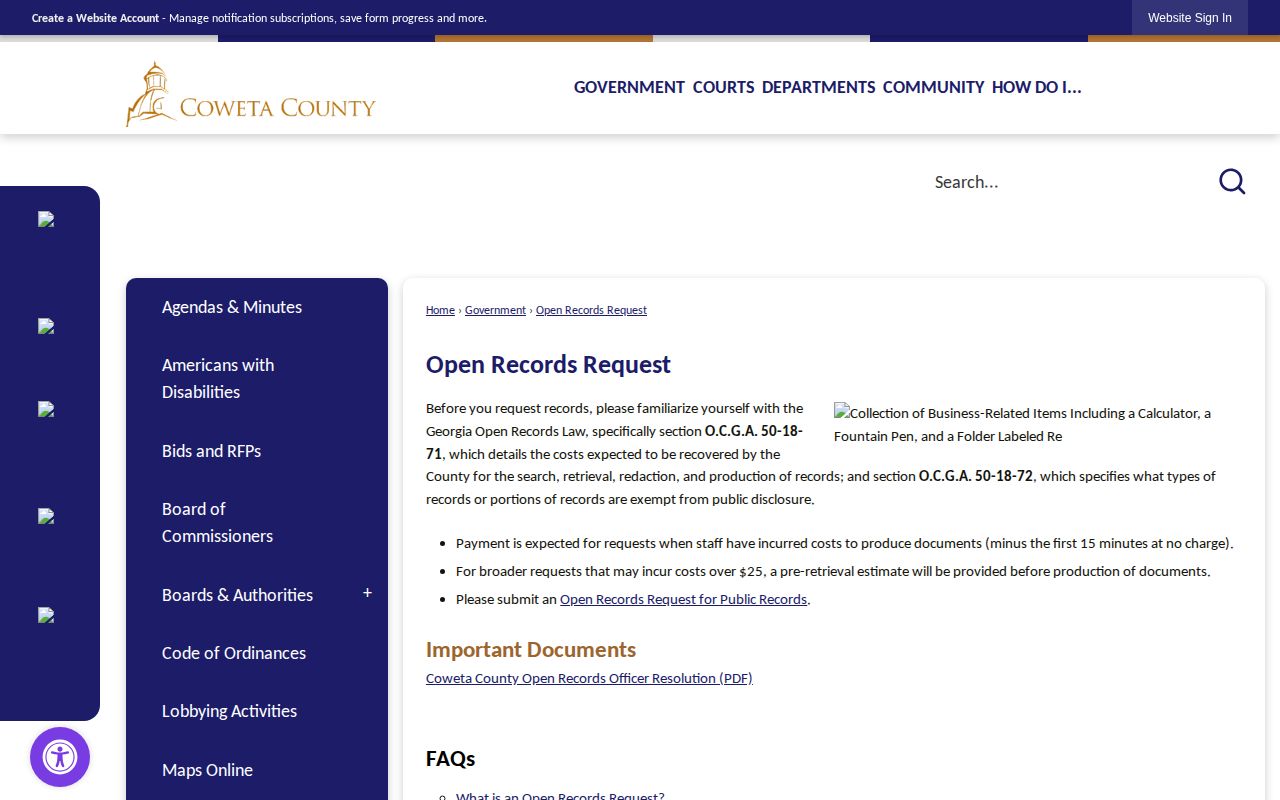
The captured county page helps identify the official request route when a released inmate no longer appears in the live Sheriff catalog.
Coweta Release Records Law
The Georgia Open Records Act, O.C.G.A. § 50-18-70 et seq., is the baseline for Coweta County public records. Section 50-18-71 addresses access, timing, and costs. Section 50-18-72 lists exemptions. Adult jail, court, and corrections records may be open, but the law does not make every field public. Juvenile information, sealed or restricted material, medical facts, victim information, and security-sensitive details may be withheld or redacted.
Retention is also not the same as online visibility. Coweta P2C does not publish a clear rule saying how long a released person stays in its public catalog. A record can stop appearing online while the Sheriff or court still holds it under the applicable retention rules. The formal request process is the correct fallback. For GDC information, the agency’s own offender-search disclaimer says to verify important facts in writing with Inmate Records and Information, P.O. Box 1529, Forsyth, GA 31029.
Correct Coweta Release Records
Georgia often uses the term “record restriction” where people may expect “expungement.” Coweta’s Sheriff records page links Record Restriction Instructions & Request. Restriction can limit public access to some criminal-history information, but it does not promise that every court, jail, agency, news, or copied record vanishes at once. The effect depends on the order, the record type, and the agency that holds it.
Start with the court disposition when a booking or release entry appears wrong, sealed, restricted, or inconsistent. Then contact the Sheriff records unit or the state agency that controls the entry. Georgia’s separate mugshot rule, O.C.G.A. § 10-1-393.5, can require a qualifying commercial publisher to remove a booking image at no charge within 30 days after a written request when a listed statutory circumstance applies. That remedy does not rewrite the official custody record, so the court and agency correction path still matters.
Note: Record restriction changes access under law; it does not automatically erase every copy held by each public or private source.
Find Coweta County Released Inmates
Begin with custody type, not one universal name search. The Coweta Sheriff catalog answers whether a local booking remains publicly visible. GDC answers whether a person is active or inactive in Georgia state corrections. The parole board addresses parole review and parolee status. Courts show what happened to a case. VINELink provides custody-status alerts. BOP, the U.S. Marshals Service, and ICE cover distinct federal stages.
- Search the Coweta Sheriff P2C inmate catalog by name and compare the arrest date, charge, court date, bond data, and release label.
- If the person is not shown, check spelling and do not treat the missing result as proof of release.
- Use the Coweta court docket for bond orders, disposition, sentence, dismissal, probation, or revocation.
- For a state sentence or the Coweta correctional institution, search GDC with inactive-offender and released-status filters.
- Check the parolee database or DCS only when parole or felony supervision may follow.
- Use Georgia VINE for an alert or status check, then verify the event with the holding agency.
- Move to BOP, federal court or USMS, or ICE ODLS when the record points to federal or immigration custody.
If none of those systems settles the question, submit the narrow Sheriff or GDC records request described above. A released person often disappears from a live custody roster because that roster is built to show current or still-visible inmates. The booking record, release record, and court docket are the durable sources.
Coweta Recent Release Search
Coweta County does not publish a confirmed standalone 24-hour or 72-hour release feed. The official Sheriff P2C routes found in the research include an inmate catalog and a recent-arrests catalog, but no separate recent-release route. Recent arrests can help identify the booking context. They cannot prove that a person later left custody.
For a recent Coweta County release, search the inmate catalog by name and read any release or expected-release label that appears. The local settings permit that label but suppress the detailed release date-time and release reason. No official update cadence or rule for how long a released record stays visible was found. When exact timing or reason matters, check the court order and request the release record from the Sheriff. VINELink can add a custody-change alert if registration occurred before the event, but the agency record remains the confirmation source.
Coweta Released Offender Search
The Georgia Department of Corrections Find an Offender tool is the primary state route for someone who served a Georgia prison sentence or was housed as a GDC offender at Coweta County Correctional Institution. It is not the first route for a short local jail stay followed by bond. After accepting GDC’s disclaimer, search by name, GDC ID, or case number. A GDC ID is a unique state correctional identifier, sometimes called a UNO.
| GDC field | Best release use |
|---|---|
| Last, first, middle name or alias | Find a person when no state ID is known. |
| GDC ID or case number | Narrow the result to a known state correctional or offense record. |
| Only inactive offenders | Search people not currently incarcerated in GDC. |
| Released in the past 15 days | Find a recent state corrections release. |
| Max prison term ending next 15 days | Look for a near-term maximum prison term end. |
| Most recent institution or conviction county | Connect the state record with a Coweta placement or a Coweta conviction. |
The GDC offender query shows the disclaimer and leads to the released, inactive, institution, and ID search controls.
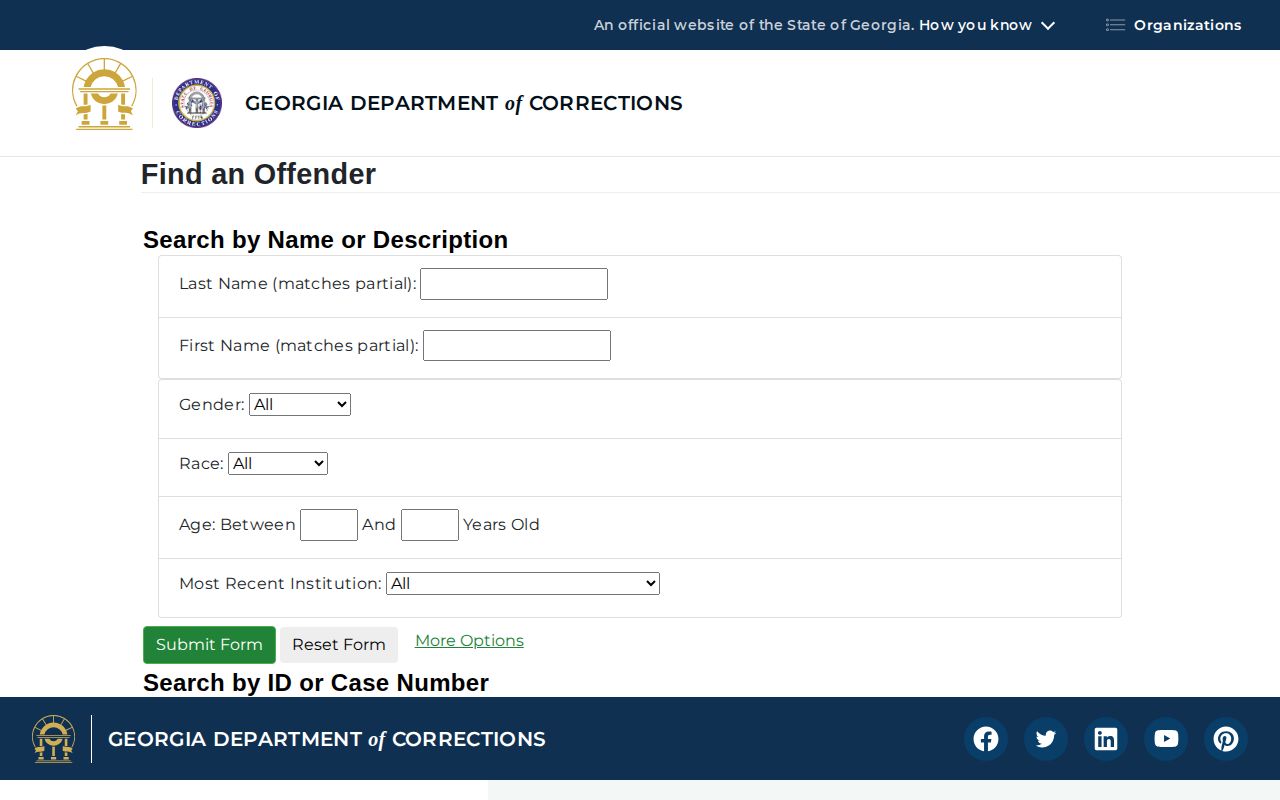
The search form is useful for state-prison release research because it can include inactive people and release-specific sentence-status filters.
Coweta Release Court Records
A Coweta County jail release and a case disposition answer different questions. Bond can end custody while a charge remains open. A later order can dismiss the charge, impose probation, revoke probation, or record sentence completion. The Coweta State Court Clerk routes civil, criminal, and traffic docket questions to its case-management system. Felony matters belong with the proper Superior Court clerk rather than State Court.
Certified copies can be more useful than a screen capture when formal proof of a dismissal, sentence, or probation termination is needed. Coweta State Court lists copies without staff help at $0.50 per page and assisted copies at $1 per page. A certified or exemplified seal costs $2.50 plus page charges. Electronic or fax copies cost $2.50 for the first page and $1 for each later page. Stored or retained items carry a $5 retrieval fee.
Why does the docket still matter after release? It records what the court did with the case, while the jail record records what happened to custody. Both may be needed to understand the full event.
Coweta Post-Release Supervision
Coweta has three supervision layers that should not be merged. The DCS Newnan Field Office serves Coweta and the Coweta Circuit for felony probation and parole. Coweta State Court Probation handles local State Court matters, commonly misdemeanor supervision. Newnan municipal probation deals with municipal court cases. A person released from jail on bond may have none of these statuses.
Before a state-prison release, the parole board’s Tentative Parole Month lookup can show the month when final review is expected. A TPM is not a release promise. Misconduct or unmet program terms can postpone or cancel it. After a parole release, the parolee database is the better status tool, and DCS provides the field-office layer. Coweta State Court Probation remains the distinct route for applicable misdemeanor cases.
Note: Parole follows a prison release, while probation comes from a court sentence; a simple bond release creates neither status by itself.
Coweta State Release Card Funds
Money and property after release depend on the facility. GDC documents a Georgia Release Card for people leaving state-prison custody. The agency says remaining funds on the person’s books are moved to that card and provides activation, PIN, and support information through its card provider. That process can apply to a GDC offender released from the Coweta County Correctional Institution.
The Georgia Release Card should not be described as the Coweta County Jail process. No official local source reviewed for Coweta documented the same card or a matching property-and-funds procedure for a bond release from Greison Trail. For a local jail release, property questions must be confirmed with the Sheriff or jail. Keeping those paths separate prevents a state-prison rule from being applied to a local booking.
Coweta Release Facility Differences
Coweta County has two distinct correctional settings in Newnan. Coweta County Jail at 560 Greison Trail is the Sheriff’s local booking and detention facility. Coweta County Correctional Institution, also called Coweta County Prison, is at 101 Selt Road and houses state and county offenders in a prison setting. GDC lists the institution at 210 capacity, while the county lists 216 beds. The figures come from different official pages and should not be forced into one number.
The institutional mission also explains the search split. GDC describes the correctional institution as holding state and county offenders and supplying a work force for Coweta County government. A person leaving there may parole, max out, transfer to another GDC site, enter a transitional center, or return to court or county control. GDC, the parole board, and DCS are central to that trail. A person leaving the Sheriff jail after bond, time served, or court order starts with P2C, the Sheriff release record, and the court docket.
- Coweta County Jail: local bookings and releases, with Sheriff P2C and records requests as the core channels.
- Coweta County Correctional Institution: state and county offenders, with GDC, parole, and DCS as key release channels.
Coweta Federal Release Checks
Georgia VINE can alert a registered user to a custody change for a specific person when the participating agency supplies the record. It is not a certified Coweta release record. A release alert can also reflect transfer from one agency to another. Confirm the destination with the Sheriff, GDC, parole authorities, or the court.
Federal custody has three separate paths. BOP covers federal inmates incarcerated from 1982 forward. BOP says a past date with no listed facility means release from BOP custody on that date, though another form of supervision or custody may remain. A federal pretrial detainee under U.S. Marshals Service control may not yet appear in BOP, so the federal court order and detention facility matter. ICE ODLS covers current ICE detainees and people held by CBP for more than 48 hours. Transfer from Coweta local custody to ICE is not a community release.
The Georgia sex offender registry is another narrow state source, not a release list. It applies only when a qualifying offense creates a duty to register. Presence can show current registration information supplied to GBI, but absence does not prove that no release occurred. Use it only for its stated registry purpose, and use the jail, GDC, or court record to confirm release.
Coweta Release Status Sources
One source rarely answers every custody question. Match the record to the agency and the point in time.
| Question | Best source | What the result means |
|---|---|---|
| Still in local jail or recently visible? | Coweta Sheriff P2C | A current or still-public local booking record, not a complete historic release archive. |
| Released from local jail? | Sheriff release record and court docket | The custody event and the separate case outcome. |
| Active or released from Georgia prison? | GDC offender search | State corrections status, institution, identifiers, and release-related filters. |
| On parole or felony supervision? | Parolee search and DCS | Post-prison parole status and the local supervision office. |
| Released from federal prison? | BOP inmate locator | Release from BOP custody, which may not end all supervision. |
| Moved to immigration custody? | ICE ODLS | Current ICE custody or qualifying recent CBP custody, not a local community release. |
Note: Save names, dates, IDs, and case numbers from each official result so the next agency can match the correct person.