
Coweta County Parole and Probation
Parole, felony probation, misdemeanor probation, and release on bond belong to separate record streams in Coweta County. The Georgia State Board of Pardons and Paroles makes parole decisions. The Georgia Department of Community Supervision, or DCS, supervises parolees and felony probationers in the community. Coweta State Court Probation handles misdemeanor matters from that court, while Newnan municipal probation serves its own court cases. A person who leaves the Greison Trail jail after posting bond may have no supervision at all.
| Status | How it begins | Primary Coweta verification route |
|---|---|---|
| Parole | Board-authorized release from a prison sentence | Parolee Database, then DCS Newnan |
| Felony probation | Probated or split sentence imposed by a court | Court record and DCS Newnan |
| Misdemeanor probation | State Court misdemeanor sentence | Coweta State Court Probation and court docket |
| Municipal probation | Municipal court sentence | The sentencing municipal court or its probation office |
| Bond release | Release while the criminal case continues | Coweta Sheriff record and the correct court docket |
Verify Coweta County Post-Release Supervision
The best lookup sequence starts with the sentence rather than the jail roster. A released person normally drops from a live custody list, and a parole record is not the same record as the Coweta County Jail booking. State-prison history points toward GDC and parole tools. A local misdemeanor case points toward the court that imposed probation. Federal supervised release is a federal court matter, not a Georgia parole entry.
- Identify whether the person left Coweta County Jail, Coweta County Correctional Institution, another GDC prison, or federal custody.
- Check the Georgia Parolee Database when release on parole is possible. This is the post-release Board tool.
- For a state correctional record, use the GDC offender search and compare the identifier, institution, conviction county, offense, and active or inactive scope.
- Use the sentencing court docket to distinguish parole from felony probation, State Court misdemeanor probation, or a municipal sentence.
- Match felony probation or parole to the DCS Newnan Field Office, which serves Coweta and the Coweta Circuit.
- Confirm a disputed or important status with the supervising agency or the court that created the record.
Note: A missing live-jail record can mean release or transfer, so it does not prove parole, probation, or freedom from another hold.
Coweta County Parole Review Records
Georgia divides the pre-release and post-release checks. Before release, the Board's Inmate TPM Lookup may show a Tentative Parole Month. A TPM is not a final decision and is not a promised release date. It marks the month in which the Board plans final review and may set a release date if release is appropriate. Good conduct and required program completion can affect it, while misconduct reports usually postpone or cancel it.
The parolee database is the more useful source after a person has actually left prison on parole. Public Board meetings do not decide individual cases. The Board publishes meetings about policy and operations, but its own public notice says offender cases and parole decisions are not handled at those sessions. For an individual result, rely on the TPM path before release and the parolee database after release.
The Georgia parole board's TPM page illustrates that distinction:
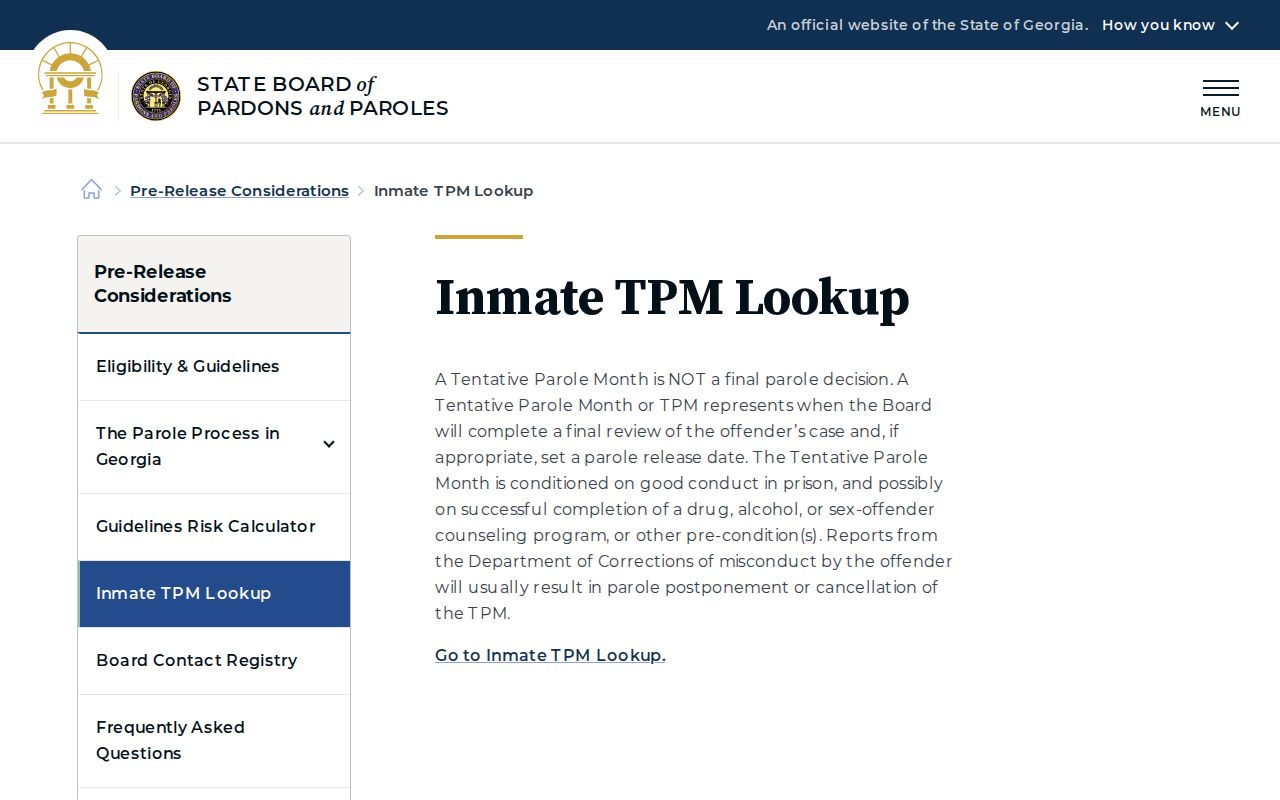
The source page should be read as parole-review guidance, not as a calendar of final Coweta County release dates.
Coweta County's Local Supervision Landscape
Coweta County has a useful local dividing line: DCS maintains a Newnan field office, but the county also has a separate State Court Probation office. DCS supervises felony probationers and parolees. State Court Probation handles misdemeanor cases within its court's authority. Newnan municipal probation covers municipal court matters. These offices may all be described in casual speech as “probation,” yet they do not hold the same files or answer for the same sentences.
The distinction also follows the two Coweta custody facilities. A bond release from Coweta County Jail at Greison Trail remains a local jail and court matter unless another sentence applies. A parole release from Coweta County Correctional Institution at Selt Road belongs in the GDC, Board, and DCS chain. If the local jail record says transfer rather than community release, check the receiving system before looking for a supervision office.
Coweta Post-Release Office Routing
The case type determines the right office. Using the sentencing court and the parolee database first can prevent a call to an agency that has no authority over the person. Coweta's three local layers are close in geography but distinct in law and record ownership.
| Record or case type | Office | Public contact in the research |
|---|---|---|
| Parole or felony probation | DCS Newnan Field Office | 51 B Perry St, Newnan; Monday-Friday, 8:00 a.m.-4:30 p.m. |
| Coweta State Court misdemeanor probation | Coweta State Court Probation | 10 Olive Street, Newnan; 770-252-6440 |
| Newnan municipal probation | Newnan Municipal Court probation | 1 Joseph Hannah Boulevard, Newnan; 770-253-1226 |
Coweta County Supervision Violations
Conditions come from the Board, sentencing court, and supervising authority. The exact terms must be read from the person's order or supervision record. A reported violation can lead to agency review, a court filing, a warrant, revocation proceedings, or a change in supervision. None of those outcomes should be inferred merely because a person cannot be found in an online search.
No official Coweta-specific public absconder list was confirmed in the research. Absconder or warrant status should therefore be checked with DCS, the parole board, the sentencing court, or the Coweta County Sheriff's Office. VINELink tracks custody changes when an agency feeds the system, but it is not a supervision-warrant database. A new custody alert may reflect an arrest, transfer, or release and needs confirmation from the agency holding the person.
Court records add context when a supervision status changes. Coweta State Court directs criminal docket inquiries to its public case-management site, and a docket may reflect probation, revocation, sentence completion, or another order. A felony matter belongs with the proper Superior Court clerk rather than State Court. If an arrest follows an alleged violation, the new jail booking answers where the person is held; the court and supervision records answer what legal action followed.
Note: Registry status is also separate. The GBI sex offender registry applies only when a qualifying offense creates a duty to register.
Coweta State Release Funds
A state-prison release can include a practical record that does not apply to a county-jail bond release. GDC says funds left on a released person's account are transferred to a Georgia Release Card. Its official page provides activation, PIN, and JPay support information. This belongs to the GDC release process for a person leaving state correctional custody, including an eligible state offender housed at Coweta County Correctional Institution.
The Georgia Release Card should not be assumed for someone leaving Coweta County Jail. No separate local jail property or fund-release procedure was established in the research. Questions about property from Greison Trail should go to the jail, while card activation and state account funds should follow GDC's Georgia Release Card guidance.
Coweta County Parole Eligibility Rules
Georgia parole eligibility law sets points for consideration, not dates of release. Under O.C.G.A. § 42-9-45, a person serving a felony sentence is generally eligible for consideration after nine months or one-third of the sentence, whichever is greater, unless another law changes the rule. Aggregated terms of at least 21 years have separate general language. Eligibility means the Board may consider the case; it does not mean parole must be granted.
O.C.G.A. § 17-10-6.1 governs serious violent felonies and imposes mandatory minimum restrictions. Other repeat-offender and mandatory-minimum laws may also change eligibility. Coweta County supervision research should use the exact sentence and applicable statute. A broad claim that every Georgia prisoner serves a fixed percentage is not supported by these sources.
GDC Performance Incentive Credit can also affect the length of stay for an eligible state offender through progress in treatment, education, vocational work, work details, and good behavior. PIC is not parole, is not automatic, and does not turn a TPM into a final date. The Board still controls parole decisions, while GDC maintains the correctional sentence record and DCS handles qualifying supervision after release.
Coweta County Supervision Discharge
Supervision ends through the authority that imposed or administers it. Parole discharge belongs to the State Board's parole record. Felony probation completion or termination should be traced through the sentencing court and DCS. State Court or municipal probation ends under the relevant local court process. A person reaching the end of a supervision term is different from a person leaving the jail, just as completion is different from an unverified absence from a database.
For the custody event that preceded supervision, the Coweta County released-inmate search and records guide explains how to match the jail, GDC, court, and records-request channels. Final proof may require a court order, an agency discharge record, or a certified copy rather than a screen view. Verify each result with the government office that created it.